STEVEN LAW
Author of Yuma Gold and the Blood for Justice series
FOLLOW ME


- AMAZON.COM #1 BESTSELLER -

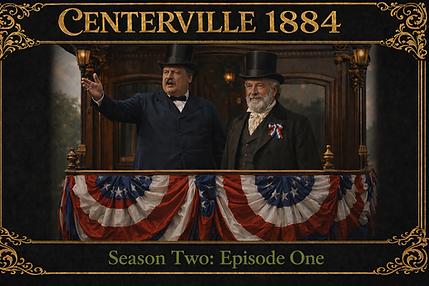


Episode 1
To be a proper newspaper man, Magnate Lawson knew that you had to study what other newspapers were doing. He subscribed to the big ones, which usually arrived many days after their publication, but nonetheless still gave him what he needed. Important national or world news came over the telegraph before they became a headline, but this news only came via his subscription.
He met Ms. Winona in the editorial office of the Daily Iowegian and laid the copy of the ‘Chicago Tribune’ on her desk.
“He’s coming through Centerville,” the Magnate said.
“Who?”
“The presidential candidate, Grover Cleveland. He’s campaigning from Chicago on the Rock Island.”
“But will our residents like it? What are his chances? I mean, he’s a democrat. There’s not been a democrat president since before Lincoln.”
“Who knows anything about the future? The question is, what if he is the next president? Do we want to miss the opportunity to have a headline of his visit? The opportunity is in the present.”
“So, you think this should be a front-page headline?”
“To announce he’s coming, and the day of his visit. I’ll talk to Stufflebeem. With his Washington connections he might be able to get you an interview.”
* * * * *
The magnate was right. Once the train arrived at the Centerville train station, a large crowd had gathered, and when the candidate stepped out of the back of the train car and waved to the crowd, the Centerville four-man brass band delivered, prematurely, “Hail to the Chief” as their musical welcome. This was when Centerville learned the band leader was a democrat.
After the music stopped and the crowd calmed, Grover Cleveland spoke of fiscal responsibility, and about ridding Washington of corruption, of which he said of his opposing candidate, “Blaine walks in that thick sludge up to his neck.”
Mayor Moritz stepped up onto the back of the train car to make his appearance with the candidate, while Tycoon Harrington and Baron Anderson skipped the festivities and went inside the luxury car from the other end, for a private meeting arranged by Banker Stufflebeem. The arrangement surprised both men because they already knew that Stufflebeem was a Lincoln Republican, and personal friend to Rutherford B. Hayes.
“Stuffy said we’d better meet with him,” the Baron said. “Blaine may win Iowa but is controversial, and several Republicans are against him which will divide the party. Besides, Cleveland was governor of New York, and that is a key state to win since Democrats usually carry all the south.”
“So, Cleveland could be our next president,” the Tycoon said.
“It’s a strong possibility,” the Baron said. “We will know in November, but for now it will be good to know what’s on his mind.”
* * * * *
When Grover Cleveland walked back inside the train car Tycoon Harrington and Baron Anderson were there to greet him. It was a friendly greeting, with firm handshakes, accompanied by Cleveland’s reach for a bottle of bourbon.
“Will you men join me?” Cleveland said,
“Absolutely,” the Baron said. “In fact, I hear you’re a Bourbon Democrat.”
“That is correct, sir,” Cleveland said, as he filled the Baron’s glass. “Certainly not all Democrats are aligned with me there, but fiscal responsibility is essential to our country’s future.”
“Can’t argue with that,” Tycoon Harrington said, as Cleveland poured bourbon into his glass. “That’s the only way we operate here in Southern Iowa.”
“And by the likes of your town mayor,” Cleveland said, “and the fact that he’s not in this meeting with us, demonstrates another way that you operate.”
Baron Anderson waved a hand at two chairs opposite Cleveland, and Tycoon Harrington sat down and the Baron sat down beside him. Cleveland kept standing.
“Mayor Moritz is a showman in his old age,” the Baron said. “At one time a very well-respected lawyer and judge, but his heart isn’t in it anymore. Leadership comes in many forms, and no one else stepped up to take that role who could lead like we can. We have to ensure the prosperity of our community.”
“Yes, I get it,” Cleveland said. “I have delt with men like you back in New York all my life. I could chew you up and spit you out as easy as a mouthful of sunflower seeds.”
“I’m sure that’s true, Mr. Cleveland,” the baron said, “but we’re not here to size each other up. What we want to know is what to expect should you be elected. How can Southern Iowa benefit from a Grover Cleveland administration?”
Cleveland raised his glass at the two men. “My compliments.”
The two men nodded and raised their glasses at Cleveland.
“As you know Iowa is a great part of America’s Breadbasket,” Cleveland said. “The opportunities are in agriculture, technology of harvesting, and meat packing. And there are many opportunities for you, Mr. Harrington, in the transporting of grains and livestock, as well as the machinery to accommodate these implements. My friends in Chicago have assured me of this growth and expansion, as well as what I’ve witnessed in visiting some of their manufacturing facilities. A man would be very wise to take notice of these changes.”
This news gave Harrington a toothy smile.
The Baron stood from his chair. “And beef, Mr. Cleveland. Do you see the future there as bright as it is today?”
“Oh yes,” Cleveland said, “And pork. The demand for hams and pork bellies will see extraordinary growth, with pork buyers and meat packing facilities. Your farmers here, if they’re not raising hogs as well as beef, they’ll be missing out on a grand opportunity.”
* * * * *
In the next episode of Centerville 1884: Baron Anderson and Tycoon Harrington meet with B. Bushell Esquire and the Bankers to discuss a plan for economic growth in Centerville. Harrington is discouraged to learn that Tycoon Strickling is already aware of their plan, and that Strickling has hired a man to head the security of his railroad. The Baron and the Tycoon meet with R. Guffey and T. Jewett about the expansion of freight and implements.
on Harrington busy with cattle shipments to Chicago and Kansas City.